
Gold Coast History and Development
From Ancient Country to One of Australia’s Fastest-Growing Cities
The story of the Gold Coast began thousands of years before its famous skyline, canal estates and beachfront communities appeared.
Today, the Gold Coast is internationally recognised for its beaches, tourism, major events and enviable lifestyle. Behind that modern identity is a rich history shaped by its Traditional Custodians, natural resources, transport connections, tourism, property development and extraordinary population growth.
The Gold Coast’s First People
The Gold Coast forms part of the traditional lands of the Yugambeh language-speaking people, whose Country extends across areas now known as the Gold Coast, Logan, the Scenic Rim and the Tweed region.
The Yugambeh language region includes several family and clan groups, including the Kombumerri people, who maintain enduring cultural, spiritual and community connections to the Gold Coast’s land, rivers, mountains and coastline.
Long before European settlement, Aboriginal communities travelled throughout the region according to the seasons, drawing food, medicine and materials from its waterways, forests and coastal environments. Their continuing knowledge and custodianship remain an essential part of the Gold Coast’s identity.
Learn more from the Yugambeh Museum.
Early European Exploration and Settlement
Captain James Cook became the first recorded European to sail past the region in May 1770. During the voyage, he named Mount Warning—known traditionally as Wollumbin—and Point Danger as navigational landmarks.
Matthew Flinders travelled past the coastline in 1802, followed by government surveyor John Oxley, who landed near present-day Mermaid Beach in 1823. Mermaid Beach was later named after Oxley’s vessel, the cutter Mermaid.
European settlement did not begin immediately. The region remained difficult to access, and its dense forests, rivers, wetlands and sandy coastal stretches presented considerable obstacles.
During the 1840s, government surveying brought greater attention to the area. Timber getters were drawn to the valuable red cedar and other hardwoods growing throughout the hinterland. Settlements emerged around waterways such as the Nerang River, which provided a practical means of moving timber towards the coast.
Nerang consequently developed as one of the district’s earliest commercial centres, while farming, grazing and sugar production helped establish communities across the northern and western Gold Coast.
Southport Becomes a Seaside Destination
Southport began developing as a seaside resort and commercial centre during the late nineteenth century.
In 1885, Queensland Governor Sir Anthony Musgrave built a summer residence near Southport, helping establish the district as a fashionable coastal retreat. The arrival of the railway from Brisbane in 1889 transformed access to the region and encouraged further residential development, tourism and trade.
By 1902, Southport had been proclaimed a town and had become the leading business and holiday centre of what was then commonly called Queensland’s South Coast.
Accommodation houses and hotels appeared as increasing numbers of visitors arrived from Brisbane. Nevertheless, travel remained relatively slow until improving roads and growing private-car ownership made coastal holidays available to more Queensland families.
Read about Southport’s heritage and the railway’s influence.
The Birth of Surfers Paradise
In 1925, hotelier James “Jim” Cavill opened the Surfers Paradise Hotel in an area then known as Elston. The hotel became a popular destination and helped establish the district as a recognisable holiday resort.
Cavill and local residents subsequently campaigned to rename Elston. In 1933, the area officially became Surfers Paradise—a name that would eventually be recognised around the world.
An emergency landing ground was established at Coolangatta in 1936 to serve aircraft travelling between Brisbane and Sydney. That modest airstrip developed over the following decades into Gold Coast Airport, now a major domestic and international gateway. More than 6.2 million passengers travelled through the airport during 2025, demonstrating its continuing importance to the region’s tourism and economy.
Gold Coast Airport passenger update.
How the Gold Coast Got Its Name
During the late 1940s, the term “Gold Coast” became increasingly associated with the South Coast’s rapidly growing tourism and property industries.
The name captured the area’s reputation for opportunity, sunshine and energetic development. It was not always intended as a compliment—some commentators used it when discussing rising land prices and commercial activity—but local businesses and residents embraced it.
On 23 October 1958, the South Coast Town Council was officially renamed the Gold Coast Town Council. On 16 May 1959, the Queensland Government proclaimed the municipality the City of the Gold Coast.
The Gold Coast had formally arrived.
The High-Rise and Canal Development Era
The 1950s and 1960s changed the appearance of the city forever.
Major canal and island developments—including Chevron Island, the Isle of Capri and Paradise Island—introduced a new style of waterfront living. Developers transformed low-lying land into residential neighbourhoods where homes could have direct access to the water.
At the same time, vertical development began reshaping Surfers Paradise.
Kinkabool, constructed between 1959 and 1960, is generally recognised as the Gold Coast’s first true high-rise apartment building. Standing ten storeys tall, it represented a dramatic move away from traditional fibro holiday cottages and low-rise guesthouses. Kinkabool remains standing today and is listed on the Queensland Heritage Register.
Discover the history of Kinkabool.
The introduction of the Surfers Paradise Meter Maids in 1965 added another colourful element to the city’s growing tourism identity. Throughout the following decades, apartment towers, hotels, shopping centres and entertainment venues continued to emerge along the coastline.
Theme Parks, Resorts and International Investment
The Gold Coast’s tourism industry expanded considerably during the 1970s, 1980s and 1990s.
Sea World, Dreamworld, Wet’n’Wild and Warner Bros. Movie World helped establish the city as Australia’s leading theme-park destination. New golf resorts, shopping centres and residential communities broadened its appeal beyond the traditional beach holiday.
International investment—particularly from Japan during the 1980s—contributed to the construction of major hotels, resorts, golf courses and high-rise developments. The city increasingly presented itself as a sophisticated international destination while retaining the relaxed lifestyle that originally attracted holidaymakers.
In 1995, the existing Gold Coast local government area amalgamated with most of Albert Shire. This brought northern growth communities and extensive hinterland areas into the modern City of Gold Coast.
Becoming a Modern Australian City
The opening decades of the twenty-first century delivered another major transformation.
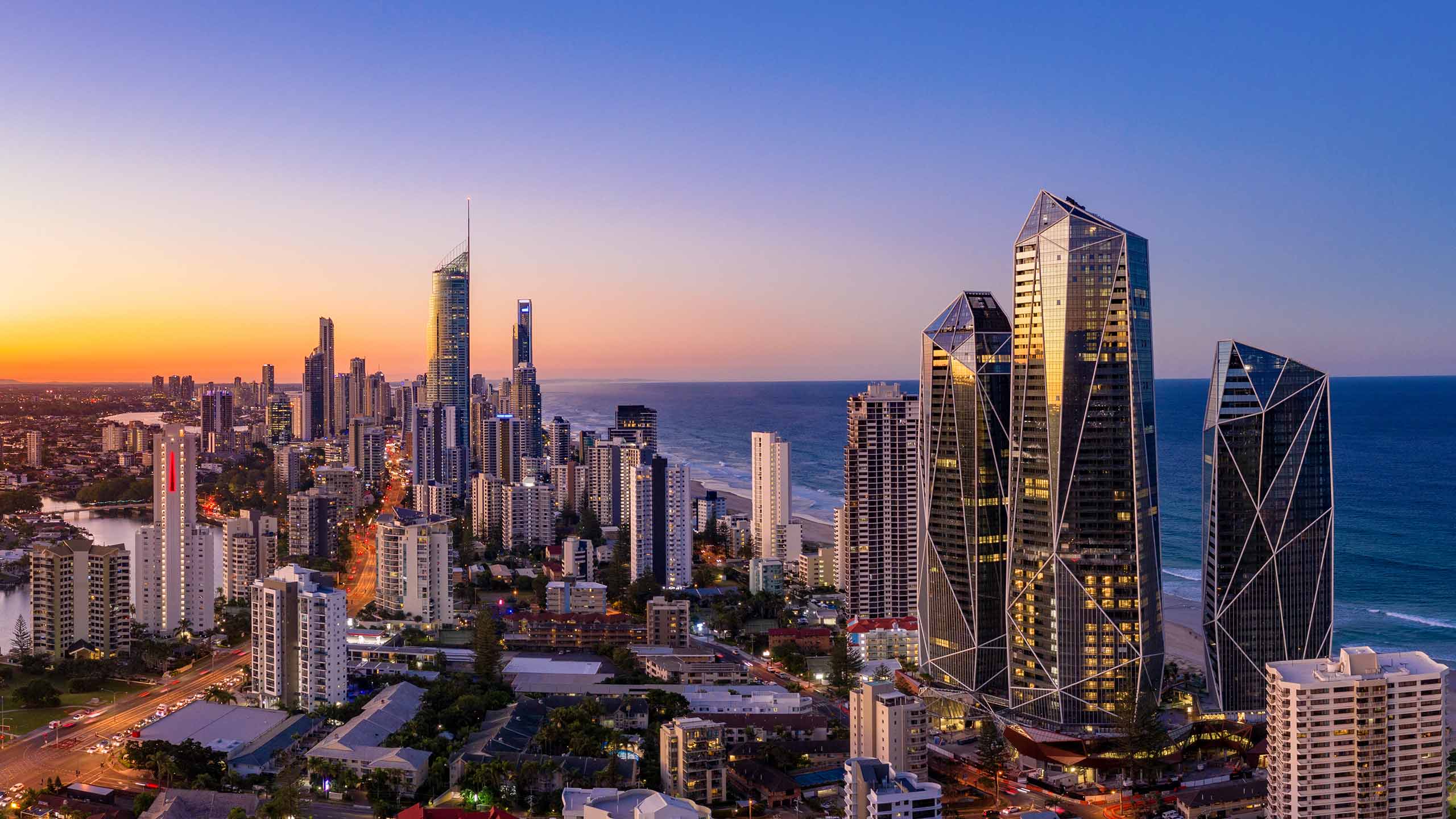
Landmark developments such as Q1, Circle on Cavill, Soul, The Oracle and the towers of Chevron Renaissance expanded the coastal skyline. At the same time, major residential growth moved north towards Coomera, Pimpama and Ormeau and west into communities such as Pacific Pines, Maudsland and the wider hinterland.
The Gold Coast also developed the infrastructure expected of a major city, including:
- Gold Coast University Hospital
- Griffith University’s expanding Gold Coast campus
- Gold Coast Convention and Exhibition Centre
- Cbus Super Stadium at Robina
- People First Stadium at Carrara
- Coomera Indoor Sports Centre
- Gold Coast light rail
- Heavy-rail and motorway improvements
- Expanding health, education and commercial precincts
The 2018 Commonwealth Games accelerated investment in sporting venues, transport, public spaces and urban renewal. It also demonstrated the city’s capacity to host an international event of significant scale.
Gold Coast Population Growth
The Gold Coast has grown from a collection of small timber, farming and seaside settlements into one of Australia’s largest and most dynamic regional cities.
The Australian Bureau of Statistics estimated the City of Gold Coast population at 691,230 in June 2025, an increase of 11,944 people—or 1.8%—in just one year.
For perspective, the city had fewer than 80,000 residents during the early 1970s. Population growth has since spread across the coastal corridor, established central suburbs, northern growth areas and hinterland communities.
The City of Gold Coast projects that the population will exceed one million residents by 2046. Meeting that growth will require a broader range of homes, employment opportunities, transport connections and community services.
The State Government’s regional planning framework has established a benchmark of approximately 161,700 additional Gold Coast dwellings by 2046.
Sources: Australian Bureau of Statistics regional population data, City of Gold Coast—State of the City 2026 and City Plan investigation areas.
Development and Infrastructure in 2026
The Gold Coast’s next phase of development is already underway.
In 2026, more than $23 billion in major projects was underway across the city, with 75 active construction cranes—a record level of development according to the City of Gold Coast.
Major transport projects include Stage 3 of the Gold Coast light rail, extending approximately 6.7 kilometres from Broadbeach South to Burleigh Heads. Planning also continues for a future extension towards Coolangatta.
The 45-kilometre Coomera Connector is being progressively developed as an alternative north–south route between Loganholme and Nerang. The northern portion of Stage 1, between Coomera and Helensvale, is already open, while the central and southern sections continue towards completion.
Gold Coast Light Rail Stage 3 and Coomera Connector Stage 1.
Looking Towards Brisbane 2032
The Gold Coast will play an important role in the Brisbane 2032 Olympic and Paralympic Games.
Six existing Gold Coast venues are proposed to host competition, including Cbus Super Stadium, People First Stadium, the Gold Coast Convention and Exhibition Centre, Coomera Indoor Sports Centre, Gold Coast Hockey Centre and the Gold Coast Sport and Leisure Centre.
Temporary competition venues are also proposed for Broadbeach and the Southport Broadwater Parklands. A Gold Coast Athlete Village is planned for Robina, adding another significant chapter to the development of this established commercial and residential centre.
Gold Coast 2032 Olympic and Paralympic Games information.
A City Still Being Shaped
The Gold Coast has always been a place of reinvention.
Timber and farming communities became holiday towns. Holiday towns became a tourism destination. That destination has now matured into a diverse city supported by construction, education, health care, technology, manufacturing, professional services, sport and international tourism.
Growth brings challenges, including housing affordability, traffic congestion, environmental protection and the need to preserve neighbourhood character. Future development will need to provide more homes and infrastructure while protecting the beaches, waterways, hinterland and lifestyle that make the city distinctive.
For property owners and buyers, understanding the Gold Coast means looking beyond short-term market movements. Its property story is closely connected to a much longer pattern of population growth, infrastructure investment, changing lifestyles and expanding economic opportunity.
From its ancient cultural foundations to its emerging role as a city of more than one million residents, the Gold Coast’s history is not simply a record of the past.
It is the foundation of what the city is becoming.

Offices in Pacific Pines and Oxenford
07 5512 1337
Send us a message to tell us what you are looking for by filling out the form below. You can also attach images, pdf's or word documents .


